



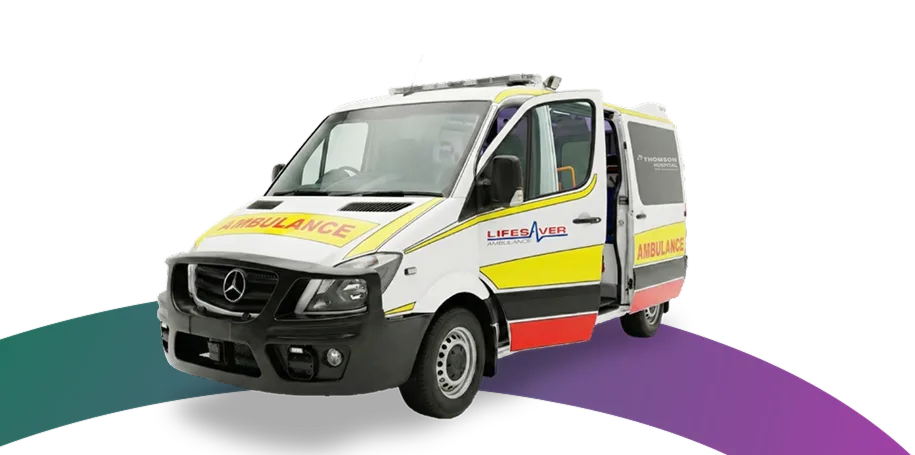


Thomson Hospital’s Emergency Department delivers rapid, expert care for heart attacks, strokes and traumatic injuries. Backed by specialised training and dedicated resources, our team acts decisively when every second counts.
First line triage
Stroke care including administration of clot-busting medications for ischemic stroke
Treatment of acute injuries (eg: fractures, burns, lacerations, and dislocations)
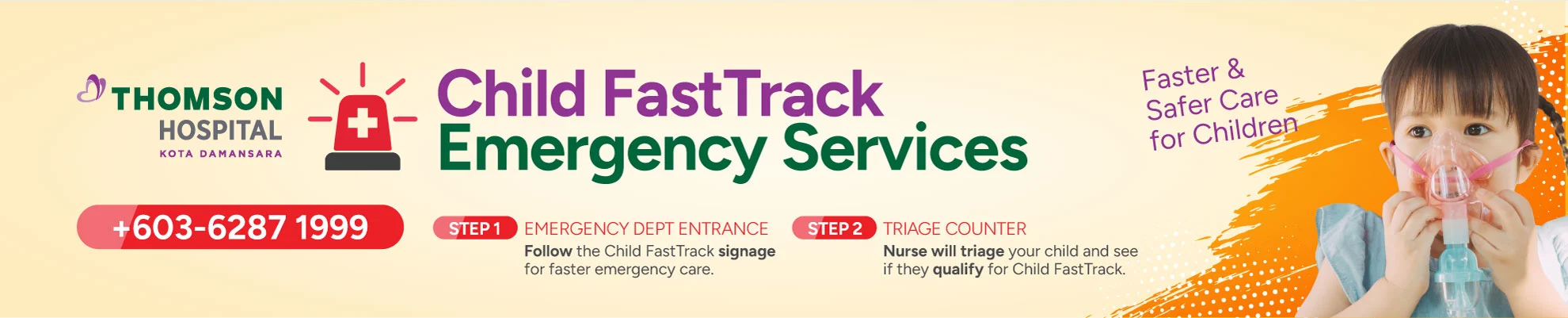
Children’s emergencies
Cardiac care (eg: heart attacks and arrhythmias)
Obstetric care (eg: complications during pregnancy)
Respiratory care (eg: difficulty breathing, respiratory distress, asthma attacks etc)
Poisoning and overdose management
Trauma care for critically injured patients (eg: severe bleeding, road accident etc)
Convulsions, fits or seizures
Any other medical emergencies
Medical team performs initial assessment on the patient. Patient is triaged into red, yellow or green zones based on urgency.
Front office staff registers new patients.
A medical officer or consultant reviews the patient’s condition.
Medical team initiates investigations, imaging and procedures.
Medical team carries out treatment, with continuous monitoring and observation.
After treatment, medical team determines patient outcome (Admission/Discharge/Referral/Transfer).
RED
(Immediate)
Requires immediate intervention
Example:
Heart attack
Severe bleeding
Collapsed patients
Stroke
YELLOW
(Within 30 minutes)
Requires urgent intervention
Example:
Severe pain
Pregnancy complications
Bone fractures
Minor burns
GREEN
(Within 90 minutes)
Less urgent intervention
Example:
Infections
Minor injuries
An electrocardiogram (ECG) is performed within 10 minutes of arrival in ED to confirm a heart attack.
If the patient has complete artery blockage (STEMI), CATH LAB will be activated immediately to perform Primary Angioplasty (PCI): The preferred "gold standard" treatment, door-to-balloon ≤90 minutes
An electrocardiogram (ECG) is performed within 10 minutes of arrival in ED to confirm a heart attack.
If the patient has complete artery blockage (STEMI), CATH LAB will be activated immediately to perform Primary Angioplasty (PCI): The preferred "gold standard" treatment, door-to-balloon ≤90 minutes
If the patient has complete artery blockage (STEMI), CATH LAB will be activated immediately to perform Primary Angioplasty (PCI): The preferred "gold standard" treatment, door-to-balloon ≤90 minutes
If the patient has complete artery blockage (STEMI), CATH LAB will be activated immediately to perform Primary Angioplasty (PCI): The preferred "gold standard" treatment, door-to-balloon ≤90 minutes
A "Stroke Alert" protocol will be activated in ED immediately when a suspected stroke patient arrives.
Diagnostic imaging CT brain (non contrast) will be performed within 20 minutes to distinguish between ischemic (blocked vessel) and haemorrhagic (bleeding) stroke.
Our neurologist will administer IV thrombolytic therapy with recombinant tissue plasminogen activator (alteplase) to dissolve clots, typically within 3 - 4.5 hours of symptom onset; or our interventional radiologist will perform mechanical thrombectomy - a minimally invasive procedure to remove blood clot and restore blood flow.
Patient will receive continuous monitoring in ICU for blood pressure, sugar, and fever to protect the brain.
Our Medical Officers will be performing Primary Survey to identify and treat life-threatening injuries in order of priority. Once life threatening injuries have been excluded, Secondary Survey (a head-to-toe examination) is conducted to identify all other injuries, including a detailed medical history.
Multi-disciplinary specialists involving trauma surgeons, intensivists, nurses and specialised therapists are available to provide treatment/lifesaving surgical procedures and manage complex, multi-organ injuries.
Post-surgical care often involves managing ongoing bleeding, trauma-induced coagulopathy (clotting issues) and multi-organ dysfunction. Patients will be monitored closely in ICU.
Multi-disciplinary critical care involving a coordinated team - Emergency Physician, Surgeons, Physicians, Intensivists and Nurses - providing 24/7, rapid-response care from pre-hospital stabilisation through ICU recovery.

Mobile App appointment booking is no longer available. Book your appointment via WhatsApp +6018-211 1878